
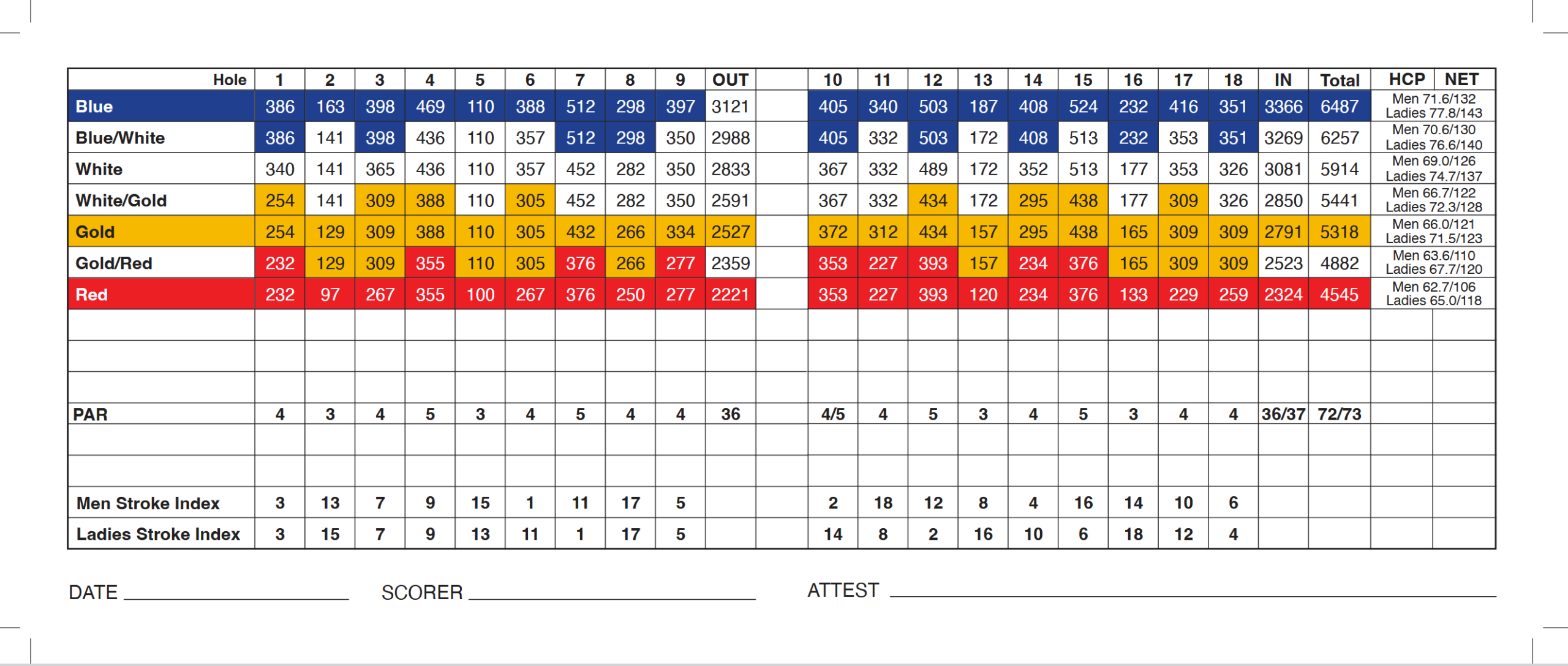
Score Card
Mississippi Golf Club · 18 holes · Par 71

Local Rules
Local Rules as of July 1, 2025 · Play is governed by the Rules of Golf as approved by Golf Canada effective January 2023.
(Proposed) Mississippi Golf Club Local Rules for Score Cards as of July 1, 2025 Play is governed by the Golf Canada approved Rules of Golf effective January 2023 and the following Local Rules:
- The prepared sandy areas at the corner on hole #4 and between holes #14 and #15 are in the general area. They are not bunkers. Players may ground their clubs.
- Flower gardens, turf nursery near #17 blue teeing area, the hedge beside #7 teeing area, young trees less than two club-lengths in height and grub damaged areas in the general area are no play zones - relief MUST be taken. In the general area take free relief Rule 16.1b. In a penalty area -take relief with one penalty stroke outside the penalty area Rule 17.1e or free relief inside the penalty area under Rule 17.1e(2) dropping within one club-length of the nearest point of complete relief not nearer the hole in the penalty area.
- A dropping zone short of the putting green may be used for a ball that enters the red penalty areas to the right of and behind #5 putting green.
- Abnormal course conditions include French drains, signal bells on #3, #6 and #12 and artificially surfaced cart paths including those surfaced with wood chips or mulch. Free relief except in a penalty area. Wood chips and mulch are loose impediments.
- When preferred lies (winter rules) are permitted, relief area within six inches of original spot.
- Provisional ball permitted on holes #1 and #6 when player is unsure whether his or her ball has cleared the penalty area.
- Local Rule for alternative to Stroke and Distance Relief for lost ball or ball out of bounds in effect for general play only. Two penalty strokes.
For full local rules, expand below
1. Out of Bounds
White Stakes are boundary objects defining out of bounds. Boundary objects are treated as immovable. They are not obstructions. No free relief.
A ball coming to rest on or beyond Wilson Street is out of bounds, even if it comes to rest on another part of the course that is in bounds for other holes.
2. Penalty Areas
Yellow and red stakes define yellow and red penalty areas respectively. Yellow penalty areas give the player two relief options - Stroke-and-Distance (Rule 17.1d(1)) and Back-On-the-Line (Rule 17.1(2)). Red penalty areas give the player an extra Lateral Relief option (Rule 17.1d(3)). Each of these relief options has one penalty stroke.
On hole #4, the edge of the red penalty area, right side and behind the putting green, is defined by the right edge of the cart path from its beginning on the corner of the dogleg to the far left end of the short fence behind the putting green where the edge is then defined by the line of uncut grass beyond the path.
The edge of the yellow penalty area that crosses the 10th and 18th holes is the outside edge of the retaining wall. The Yellow stakes placed just outside the penalty area identify this penalty area but do not define the edge of the penalty area. If a player’s ball comes to rest touching or near the retaining wall so that the player has interference by the wall with their stance or area of intended swing, the player is entitled free relief one club length from the nearest point of complete relief no nearer the hole.
3. Prepared Areas of Sand That are Not Bunkers
The prepared areas of sand on the right side before the corner of hole #4 and between holes #14 and #15 are part of the general area. They are not bunkers. A player may ground their club in these areas without penalty.
4. No Play Zones
All flower gardens, the cedar hedge between holes #6 and #7, turf nursery hole #17 near blue tee, young trees that are tagged, staked, or less than two club lengths in height, and any grub damaged areas in the general area are no play zones that are to be treated as abnormal course conditions. Relief must be taken from these no play zone as follows:
- If a player’s ball lies anywhere on the course other than in a penalty area and it lies on or touches a no play zone or the no play zone interferes with the player’s stance or area of intended swing, the player must take free relief under Rule 16.1f. Drop within one club-length of the nearest point of complete relief.
- If the ball lies in a penalty area, and interference to the player’s stance or area of intended swing exists from a no play zone, the player must take relief with one penalty stroke under Rule 17.1e outside the penalty area or free relief under Rule 17.1e(2) inside the same penalty area.
5. Yardage Markers
Red markers indicate 100 yards, white 150 yards, blue 200 yards, and yellow 250 yards. They indicate the distance from the marker to the centre of the putting green following the centre line of the fairway. Yardage markers are immovable obstructions. Free relief under Rule 16.1b.
6. Dropping Zone on Hole #5
If a ball has crossed into the red penalty area to the right of and behind the putting green on hole #5 including when it is known or virtually certain that a ball that has not been found crossed into and came to rest in this penalty area:
The player has these relief options, each for one penalty stroke:
- Take relief under Rule 17.1; or
- As an extra option, drop the original ball or another ball in the dropping zone short of #5 putting green. This dropping zone is defined by the border between cut and uncut grass. This dropping zone is a relief area under Rule 14.3.
Note: The following points apply when dropping a ball in a dropping zone:
- The player does not have to stand in the dropping zone when dropping the ball.
- When a player is using a dropping zone, the relief area is defined by that dropping zone and the ball must be dropped in and come to rest in the dropping zone (see Rule 14.3).
7. Abnormal Course Conditions include:
- Areas defined by white lines
- Drainage ditches filled with stones (French drains)
- Seams of cut turf – Model Local Rule F-7 is in effect. Interference exists if a player’s ball lies in or touches a seam of cut turf or a seam interferes with the player’s area of intended swing. However, interference does not exist if the seam only interferes with the player’s stance. All seams within the area of cut turf are treated as the same seam.
- Immovable obstructions – signal bells on holes #3, 6 and 12, and artificially surfaced roads or paths and
- Bare rock in the fairway of the hole you are playing.
- Free relief under Rule 16.1. Drop one club-length from the nearest point of complete relief, no nearer the hole.
8. Wood Chips and Mulch
- Wood Chips and Mulch are loose impediments.
9. Integral Objects
The following are integral objects from which free relief is not allowed
- wrappings
- wires
- cables
- other objects closely attached to trees.
10. Preferred Lies (Winter Rules)
If the Committee chooses to allow preferred lies (winter rules) then:
When a player’s ball lies on the fairway of the hole he or she is playing, the player may take free relief once by placing the original ball or another ball in and playing it from the relief area that is within 6 inches of the spot of the original ball, not nearer the hole than that spot and in the general area.
In proceeding under this Local Rule, the player must choose a spot to place the ball and use the procedures for replacing a ball under Rules 14.2b(2) and 14.2e.
Players should check with the Pro Shop to determine if winter or summer rules apply. This information may also be posted outside the Pro Shop or at the first tee.
For purposes of this Local Rule, “fairway” means any area of grass in the general area that is cut to fairway height or less.
For general play only, a player is permitted to roll the original ball with his or her clubhead to a spot within 6 inches of the spot of the original ball in the general area no nearer the hole than that spot.
11. Aeration Holes
If a player’s ball lies in or touches an aeration hole:
- Ball in general area: The player may take free relief under Rule 16.1b, i.e., by dropping the original ball or another ball within one club-length of the nearest point of complete relief, in the general area, no nearer the hole.
- Ball on putting green: The player may take free relief under Rule 16.1d, by placing the original ball or another ball on the spot of the nearest point of complete relief on the putting green or in the general area.
But interference does not exist if the aeration hole only interferes with the player’s stance or, on the putting green, on the player’s line of play.
12. Practice
Rule 5.2b is modified in this way:
A player may practice on the course on the day of the competition before the following stroke play competitions:
• Ladies Twilight on Tuesday, and
• Men’s Night on Thursday.
13. Provisional Ball for Ball in Penalty Area on Holes #1 and #6
If a player does not know whether his or her ball is in the yellow penalty area in front of the putting green on hole #1 after playing a stroke from the general area across the yellow penalty area toward the putting green or in the red penalty area on hole #6 after playing a stroke from the general area across the red penalty area toward the putting green, the player may play a provisional ball under Rule 18.3, which is modified in this way:
In playing the provisional ball, the player may use the stroke-and-distance relief option (see Rule 17.1d(1), the back-on-the-line relief option (see Rule 17.1d(2)) or on hole #6 only, the lateral relief option (see Rule 17.1d(3)).
Once the player has played a provisional ball under this Rule, he or she may not use any further options under Rule 17.1 in relation to the original ball. In deciding when that provisional ball becomes the player’s ball in play or if it must or may be abandoned, Rule 18.3c(2) and 18.3c(3) apply except that:
- When Original Ball Is Found in Penalty Area Within Three-Minute Search Time. The player may choose either to:
- Continue to play the original ball as it lies in the penalty area, in which case the provisional ball must not be played. All strokes with that provisional ball before it was abandoned (including strokes made and any penalty strokes solely from playing that ball) do not count, or
- Continue to play the provisional ball in which case the original ball must not be played.
- When Original Ball Is Not Found Within Three-Minute Search Time or Is Known or Virtually Certain to Be in Penalty Area. The provisional ball becomes the player’s ball in play.
14 Alternative to Stroke and Distance for Lost Ball or Ball Out of Bounds
For general play only:
“When a player’s ball has not been found or is known or virtually certain to be out of bounds, the player may proceed as follows rather than proceeding under stroke and distance.
For two penalty strokes, the player may take relief by dropping the original ball or another ball in this relief area (see Rule 14.3):
Two Estimated Reference Points:
- Ball Reference Point: The point where the original ball is estimated to have:
- Come to rest on the course, or
- Last crossed the edge of the course boundary to go out of bounds.
- Fairway Reference Point: The point of fairway of the hole being played that is nearest to the ball reference point, but is not nearer the hole than the ball reference point.
For purposes of this Local Rule, “fairway” means any area of grass in the general area that is cut to fairway height or less.
If a ball is estimated to be lost on the course or last crossed the edge of the course boundary short of the fairway, the fairway reference point may be a grass path or a teeing ground for the hole being played cut to fairway height or less.
Size of Relief Area Based on Reference Points: Anywhere between:
- A line from the hole through the ball reference point (and within two club-lengths to the outside of that line), and
- A line from the hole through the fairway reference point (and within two club-lengths to the fairway side of that line).
But with these limits:
- Must be in the general area, and
- Must not be nearer the hole than the ball reference point.
Once the player puts a ball in play under this Local Rule:
- The original ball that was lost or out of bounds is no longer in play and must not be played.
- This is true even if the ball is found on the course before the end of the three-minute search time (see Rule 6.3b).
But the player may not use this option to take relief for the original ball when:
- That ball is known or virtually certain to have come to rest in a penalty area, or
- The player has played another ball provisionally under penalty of stroke and distance (see Rule 18.3).
A player may use this option to take relief for a provisional ball that has not been found or is known or virtually certain to be out of bounds.
Course Information
Maintaining outstanding course conditions takes planning, care, and attention to detail. Explore the information below to learn how we care for the course and keep it in top condition every day.
Frost Delays
In spring and fall we will experience playing delays due to frost. When a frost occurs, the course management will put a notification on the daily tee sheet indicating this and there will be a delay in tee times.
On these mornings, play will not start until the frost on the grass has melted, as in spring and fall frost appears on the longer grass before the greens. To minimize delays, tee-offs will begin on the Carleton Place Nine (the back nine) as the holes on this nine are not as sheltered as those on the Almonte Nine (the front nine) and the frost melts more quickly.
Frost damage can occur on any height of mowed grass, but it is amplified when the plant is mowed low, as on a green. Frost is essentially frozen dew. Ice crystals visible on the outside of the plant can also form on the inside of grass blades. The grass plant, normally resilient to footsteps or cart traffic, becomes brittle and fragile when ice crystals form. Under the pressure of traffic, ice crystals puncture living plant tissues and rupture plant cells. Damage will not appear right away, but it will show up in footsteps in the following days as the plant is unable to repair itself and begins to die and turn black. The recovery from this severe damage can take months.
Keep in mind, a foursome typically takes several hundred footsteps on each green, so even allowing just a few groups to play when frost is present can be very damaging to the greens. It is not completely understood when frost will cause damage, so the decision to keep traffic off the golf course is made conservatively to protect the condition of the course. For this reason, the Mississippi will close the course to play or delay starting times until frost has completely melted.
December 5,, 2018
Sources: USGA and the MGC
Early Tee Times
Each morning’s course maintenance activities are scheduled and sequenced to ensure they are performed efficiently and effectively to provide the best playing conditions possible.
We commence work at 5:00 on the front nine and plan on two hours per side to complete the scheduled work program for the day.
We understand some players like to play early and book the first tee times of the day. However, if a player or players tee off before the first tee time of the day or attempt to play their round in three hours or less they may catch up with maintenance staff performing their duties.
The following activities are performed daily:
- Cutting the greens
- Cutting new hole placements
- Tee block placements
In addition, the following activities may be performed:
- Rolling the greens
- Fertilizing the greens
- Top dressing the greens
- Cutting the tees
- Over-seeding the tees
We ask players to please yield to the staff and give them the right-of-way to finish their respective tasks properly without having to rush. This will ensure that our course condition is maintained to the usual high standard and provide an enjoyable playing experience.
Jan 15, 2020
Greens
Introduction
The Mississippi is committed to enhance the playing experience of members and guests by providing greens that provide a firm uniform surface to putt on.
Grasses are specifically selected for use on putting greens. At the Mississippi, the greens are made up of bentgrass and Poa annua type grasses.
Newer greens are mostly composed of sand. These types of greens are commonly known as USGA built greens and tend to be firm and provide a fast putting surface. The first and the eighteenth greens at the Mississippi are of this type.
Our other greens at the Mississippi are soil-based putting greens known as “push-up” greens. To ensure we provide the fastest and truest putting surface possible on our greens, we have implemented a comprehensive maintenance program of aeration, topdressing and rolling. The aeration and topdressing programs will occasionally disrupt playing conditions but are aimed at maintaining and improving the putting greens and their soils.
Our objective is to ensure that Mississippi greens run at 10 to 11 on the Stimpmeter.
The following information is provided to help understand our maintenance program and the resources needed to provide the best greens possible.
Mowing
Greens are mowed seven days per week, weather permitting. This mowing frequency helps promote a dense turf. Our greens are mowed at a height of 0.140 inches from opening day and gradually reduced to a mid-summer height of 0.125 inches. Starting at the beginning of October, height is gradually increased to 0.140 inches.
Starting the third week of June to the beginning of September, the greens are double cut daily.
Green aprons and approaches are mowed Monday, Wednesday and Friday to a height of 0.50 inches.
Aeration
The three important objectives of aeration are to relieve soil compaction, improve the soil mixture around the highest part of a green’s roots, and reduce or prevent the accumulation of excess thatch.
In mid-May and late August, the greens are aerated by punching a half-inch diameter core with a depth of 3 inches followed by top dressing. In late fall, a three-quarter inch core is punched to a depth of 6 inches and left open.
Venting
Venting of the greens is done on an as-required basis. Venting creates thousands of small holes, which allows air and moisture into the soil. This is critical during hot stressful times. It is also beneficial during dry weather as it prevents surface sealing of the grass. We roll the greens right after venting so there is a minimum impact on the surfaces.
Vertical Cutting
Verticutting involves the use of vertically operated rigid blades that cut into the turf perpendicular to the surface. It is done to control the lateral growth of bentgrass and is done as required, when growth is too tight.
Light Top-dressing
Top-dressing is the spreading of a thin layer of sand on the green. This is done to smooth the surface, control thatch for modification of the surface soil and to provide a firm, tight putting surface. We top-dress every 10 to 14 days from the beginning of May until September, when the turf is actively growing. We mow the greens first, then top-dress. The material is brushed and watered in and we follow up with a second mowing.
Rolling
This operation smooths the putting surface and increases green speed. Rolling is done on Monday, Wednesday and Friday each week and on both days on the weekend. Care is taken to ensure that conditions are appropriate for this procedure. We use a Toro GreensPro 1240 roller to perform this work.
Growth Regulators
We use growth regulators on our greens throughout the growing season. The product we use is called T-NEX (Trinexapac-ethyl). It is applied weekly, generally from June 1 to mid-September. It encourages grass to spread, as opposed to growing upwards.
Fertilizing
Granular slow-release fertilizers are used at low rates every 4 to 6 weeks on the greens. In addition, we apply water-soluble fertilizer once a week.
Wetting Agent
A wetting agent is applied to the greens once a week to reduce the surface tension of water molecules, which allows them to infiltrate the soil more effectively. This helps maintain a firmer putting surface and allows us to use less water when watering.
Pesticide Applications
Pesticides are applied to the greens on an as-required basis to help keep turf healthy by reducing damage caused by insects and fungus diseases. For additional information see Pesticide Use.
Watering
Moisture readings are taken once a day on the greens. When and how much to water is also based on several other factors, such as topdressing, fertilization and aerification. We try to water the greens as effectively as possible to help keep them firm.
Winter Protection
In preparation for winter, the greens are sprayed with three applications of a fungicide which prevents snow mould or fusarium patch. The first application is done in mid-October, the second at the beginning of November and the last just prior to the greens being covered with tarps, which is generally in mid-November.
The greens are covered with two types of tarps. The first is a bubble type which is laid directly on the green. This is then covered with an ice shield tarp. Some of our high-risk greens are covered with a double layer of the bubble type tarp.
Ten of our greens are fitted with perforated piping under the tarps which we blow air into every two weeks during the winter. The greens are also inspected regularly.
July 01, 2020
Fairways and Rough
Introduction
The Mississippi is committed to enhance the playing experience of members and guests by maintaining fairways that provide a lush, uniform surface to hit off and rough that is challenging but fair.
Grasses are specifically selected for use on the fairways and the rough. At the Mississippi, the fairways and rough are a mixture of blue grass and Poa annua.
The following information is provided to help understand our maintenance program and the resources needed to provide the best fairways and rough possible.
Rough
The rough is mowed to a height of 2.50 inches on uneven areas and 2.25 inches on flat areas. The rough is cut twice a week.
The rough is fertilized once a year in June with granular slow-release fertilizer, which helps prevent weeds and grubs. Throughout the season the rough is also spot sprayed for weeds.
Fairways
Fairways are cut Monday, Wednesday and Friday to a height of 0.540 inches.
Fairways are fertilized every two weeks throughout the season with a either a low-dose water-soluble or a granular slow-release fertilizer.
Aeration of the fairways is conducted up to twice a year in spring and fall but is dependent upon weather conditions. The spring aeration removes a three-quarter inch diameter core with a depth up to 3 inches. In the fall, a three-quarter inch diameter core is punched to a depth up to 3 inches. The aeration program will occasionally disrupt playing conditions but is aimed at maintaining and improving the fairways and their soils.
Depending on the weather conditions, a fungicide is applied four times each summer to the fairways.
Moisture readings are taken once a day on the fairways. When and how much to water is also based on several other factors, such as fertilization and aerification. We try to water the fairways as effectively as possible.
July 01, 2020
Tee Boxes at the Mississippi
We strive to provide our members and guests with well-maintained tee boxes to allow for that first critical shot on each hole. The following information is provided to help understand our maintenance program and the resources needed to provide the best tee boxes possible.
Grasses are specifically selected for use on the tee boxes. At the Mississippi, the tee boxes are a mixture of blue grass and Poa annua.
Tee boxes are mowed Monday, Wednesday and Friday to a height of 0.50 inches and over-seeded once a week.
In the spring and fall the tee boxes are aerated by removing a half-inch diameter core with a depth of 3 inches followed by top dressing.
Granular slow-release fertilizers are used at low rates every 3 weeks on the tees with over seeding (filling of divots) done daily.
Depending on the weather conditions, a fungicide is applied two to three times each summer, and throughout the season the tee boxes are spot sprayed for weeds.
Moisture readings are taken once a day on the tees. When and how much to water is also based on several other factors, such as topdressing, fertilization and aerification. We try to water the tee as effectively as possible.
In preparation for winter, the tees are sprayed with two applications of a fungicide which prevents snow mould or fusarium patch. The first application is done in mid-October and the second at the beginning of November.
The most exposed tee boxes are covered with an ice-shield type tarp.
July 01, 2020
Bunkers
Introduction
Bunkers are specially prepared areas to test the player’s ability to play a ball from the sand. They require strategy, provide challenge and aesthetics and can be a continual topic of discussion after a round.
At the Mississippi we have the two types of bunkers used in golf course architecture.
We have 13 fairway bunkers. These are designed primarily to gather up wayward tee shots on our par 4 and par 5 holes; they are located to the sides of the fairway.
Our 26 greenside bunkers, located near or around the green, are designed to collect wayward approach shots on longer holes and tee shots on par 3 holes.
We also have two large sandy waste areas that are not bunkers. They are the long sand area between holes 14 and 15 and a smaller area at the corner of hole 4.
Our greenside and fairway bunkers are a mixture of flash-faced and flat bunkers. Flash-faced bunkers are higher-lipped bunkers where the sand extends high up the sides.
We use two different types of sand in our bunkers. In the greenside bunkers it is a finer type of sand, and is the same type as we use to light top dress our greens. In the fairway bunkers it is a coarser type of sand, and is the same type as we use to top dress our greens following aeration.
Maintenance
We strive to rake our bunkers Tuesday, Thursday and on both days of the weekend. Larger bunkers are raked by machine while the smaller bunkers and the faces of flashed-faced bunkers are raked by hand.
Edging of the greenside bunkers is scheduled for every two to three weeks and the fairway bunkers are edged approximately three times a year.
The machine exits of the bunkers are re-sodded in the fall as required.
July 01, 2020
Pesticide Use
Pesticides come in a variety of different forms. At the Mississippi we basically use the three following types:
- Fungicides – Designed to eliminate or control fungus. They may also be designed to render specific forms of fungus harmless to our grasses.
- Herbicides – Created to eliminate or reduce the presence of invasive plant species and weeds.
- Insecticides – Focus on suppressing, killing, or inhibiting infestations or feeding by one or more types of insects.
The Mississippi is registered and has received accreditation from the Ontario Ministry of Environment-approved Integrated Pest Management (IPM) body. This allows us to use Class 9 pesticides at the golf course.
IMP and the Ministry requirements include the following:
- post warning signs to notify golfers of pesticide use on playing surfaces;
- prepare an annual report summarizing all pesticide use on the course;
- conduct an annual public meeting with the neighbours (within 100 meters) of the golf course.
December 5, 2018
Our Irrigation System
During the fall of 2017 and the spring of 2018 the Mississippi installed a new a Toro computer-controlled irrigation system. The Toro two-wire system, in conjunction with its Lynx software, uses innovative technology to provide reliable and efficient irrigation control.
The decision to upgrade our aging manual irrigation system was born out of the desire to obtain better control of our water and hydro resources and provide optimum playing conditions for our members and guests, while eliminating the need for night-time manual watering and the associated safety issues.
Using the system’s station-based flow management and “to the second” control we have reduced our watering window, water usage, hydro costs and wear and tear on our pipes and pumps. The Lynx mobile apps give our course managers full control and manipulation of the irrigation system through their smart devices. Now real-time decisions can be made, on or off-site, that will keep the turf in optimal growing and playing condition, without disrupting play.
The modular sprinkler head system has eliminated the need to disturb the turf for any regular (or irregular) maintenance required. Using a huge selection of nozzles in both full-circle and part-circle configurations with elevation control, we can apply irrigation with extreme precision; watering exactly where, when and how much the turf needs. Having installed more than 450 heads gives us the ability to fine tune practically every square foot of the golf course.
We believe our new system has enabled us to elevate course conditions and improve our members’ and guests’ golfing experience, while freeing up our staff to attend to other matters.
March 12, 2020
Restricted Use of Golf Carts During Wet Conditions
The use of golf carts plays an important role at the Mississippi. They provide a revenue source and increase the accessibility for our members and guests who might not otherwise be able to play the course.
However, golf carts can have very negative impacts on turf health and playing conditions, especially during wet conditions. Therefore there will be days where carts will not be allowed out on the course. This occurs when the course is deemed to be too wet.
Unfortunately, wet course conditions and cart traffic do not mix. Carts can slide, skid and sink when turf is wet, causing immediate and lasting damage. Compaction of wet turf can also have a negative long-term effect on playing conditions, even if those impacts are not immediately visible. Compacted areas are more susceptible to diseases such as dollar spot, fusarium patch, typhula blight, pythium blight and Rhizoctonia brown patch.
The decision to restrict the use of carts is not made or taken lightly.
Before the decision is made following a rain event, several steps are taken to evaluate the condition of the course. First, the previous day’s fairway moisture readings are examined. (Note that moisture readings are taken daily on the fairways, greens and tees.) Second, the exact amount of rainfall is determined using data from the weather station at the course’s maintenance area. Finally, a visual inspection of the course is made to evaluate the presence of standing water. Based on all this information, a decision is made regarding cart usage.
With the variation in drainage rates on the course, certain areas will appear dry enough to allow the use of carts. However, we have to protect the entire course and we ask for your patience and understanding. We don’t want to put the cart before the course.
May 7, 2020
Sources: USGA and the MGC
Our Course Dog
Like many golf courses, the Mississippi employs the services of a dog to help with wildlife control on the course. Our course dog is Willow.
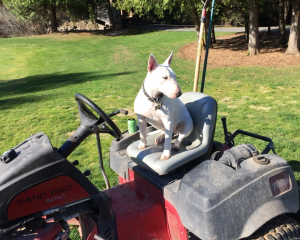
Willow is a 5-year-old female English Bull Terrier. The look of an English Bull Terrier can be intimidating to some people, but this breed has a good temperament and is very friendly toward family, children and strangers. Our Willow has these exact traits as she really likes people. She has also successfully passed Behavioural Training.
Willow has worked at the MGC for 4 years, during which time she has become a key element of the MGC wildlife control program.
She works on the course 6 days a week controlling the wildlife, particularly the Canada Geese and the groundhogs and has significantly reduced their activity and damage.
Willow tours the course with the Assistant Superintendent first thing every day before the course opens to control the geese. They also do another tour in the early afternoon. Under no circumstances is Willow allowed to run free unattended.
Director of Greens
July 19/19
Thunderstorms and Lightning Strikes
Mississippi Golf Club does not have or utilize any safety systems to detect or predict inclement weather. Golfers play at their own risk and are therefore responsible for determining when they should get off the golf course if thunderstorms are in the area.
According to the Canadian Lightning Detection Network (CLDN), lightning can strike more than 16 kilometers away from a storm. That includes ahead of or behind a lightning storm, so even if it’s not raining you can be struck.
Not sheltering under a tree is paramount. Go to a safe location: either a building with plumbing and wiring or an all-metal vehicle.
Our rain shelters offer NO protection against lightning.
We recommend that you follow the excellent advice from the National Lightning Safety Institute: "If you can see it (lightning), flee it; if you can hear it (thunder), clear it."
While you are glancing at the radar imagery on your cell phone, remember that the weather doesn’t have to be upon you before it could become a serious hazard.
Looking for a reliable web site for your cell phone? Try looking up the Canadian Lightning Danger Map on the Internet and bookmarking an icon to your mobile. Also you may wish to download the WeatherCAN weather app.
March 25. 2026
Safety at the Mississippi
It is the obligation and intent of The Mississippi Golf Club to provide a safe and pleasant environment for our members, guests and visitors, as well as to protect the Club’s reputation, property, and operations.
To help us fulfill this obligation the Mississippi has set up the following email address.
This address is to be used to convey a safety issue or concern on the course such as a trip or fall hazard. Examples could be a hole or rut where an ankle could be twisted, a loose step or a tree branch overhanging a cart path which is touching power cart roofs.
Emailed safety concerns are sent directly to the Club’s Greens Superintendent, the Pro Manager and the Greens Director for immediate investigation and rectification.
August 12, 2020
Emergency Medical Equipment
The following emergency medical equipment is available at The Mississippi Golf Club and located in the indicated areas.
First Aid Kits:
- In the Pro Shop
- In the main Maintenance building
- On the Beverage Cart
Defibrillators:
- In the Pro Shop
- In the main Maintenance building
- On the Beverage Cart
EpiPen:
- In the Pro Shop
Naloxone Kit:
- In the Pro Shop
- In the main Maintenance building
- On the Beverage Cart
April 12, 2023